Introduction
Land rent and land rates are important aspect for every property owner in Kenya to understand. Failure to comply can result in penalties, difficulties when transferring property, and delays in obtaining land clearance certificates. The two have different legal payments collected by different levels of government.
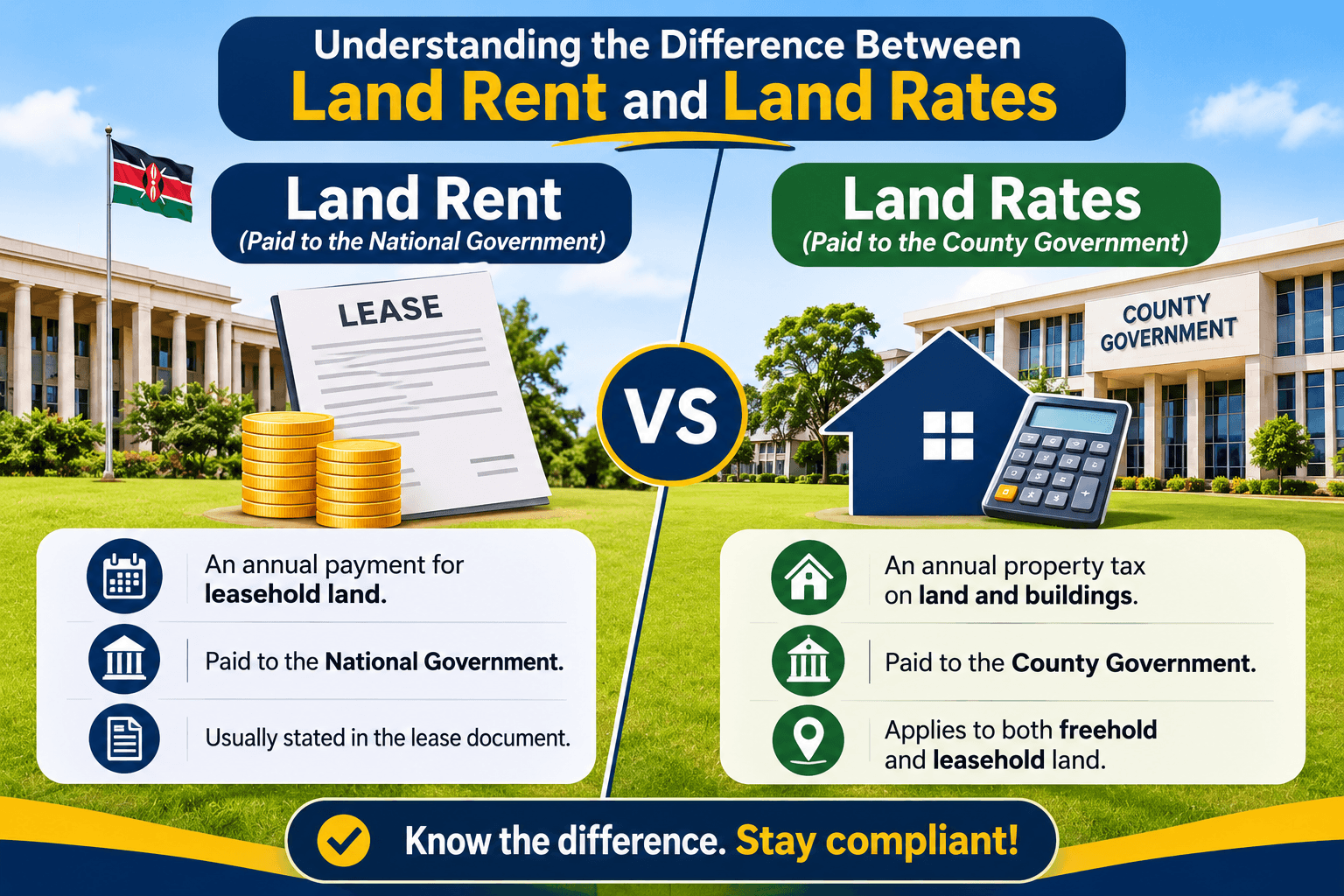
Land rent is an annual payment made by owners of Leasehold land to the National Government. It is paid to the Ministry of Lands through platforms such as Ardhisasa or eCitizen, depending on the property’s location.
In Kenya, leasehold ownership means that a person holds an interest in land for a specified period rather than owning the land indefinitely. The lease is subject to conditions contained in the lease document, which may include payment of annual land rent.
Purpose of Land Rent
Land rent serves several purposes:
How is Land Rent Calculated?
Unlike land rates, land rent is generally specified in the lease document (Grant or Certificate of Lease). The amount varies according to:
There is therefore no uniform national land rent amount.
What are Land Rates?
Land rates are annual property taxes imposed by County Governments on land within their jurisdictions, usually towns, cities and municipalities. The owners of ratable property within county boundaries are required to pay land rates annually
The National Rating Act, 2024 provides the current national framework for county governments to impose rates on land and buildings. It also provides for different approaches to determining rates, including consideration of property value, annual rental value and area-based rating.
Unlike land rent, land rates apply to both freehold and leasehold land.
Purpose of Land Rates
Revenue collected from land rates is used by county governments to finance local services including:
Land Rent
Land rent is payable to the National Government identified as the head lessor under the relevant lease.
However, the applicable lease and head lessor should always be checked rather than assuming that every property follows exactly the same arrangement.
Land Rates
Land rates are levied by the County Government in whose jurisdiction the property is located.
For example:
A property in Nairobi may be subject to Nairobi City County rates.
A property in Mombasa may be subject to Mombasa County rates
Are Land Rent and Land Rates Paid on All Land?
Land rent: Mainly applies to leasehold properties where rent is required under the lease. The title, lease terms, and official land records should be checked.
Land rates: Apply to ratable property under the relevant county's rating laws, subject to exemptions and exclusions. The specific county's laws, valuation roll, and rating system determine the liability.
Land rent is based mainly on the lease terms and government determination. The amount may be reassessed after events such as subdivision, change of user, lease extension, or other changes affecting the property. Therefore, owners should verify the current land records rather than relying on the amount previously paid.
| Item | Land Rent | Land Rates |
|---|---|---|
| Basic nature | Rent associated with a leasehold interest | Property/land charge imposed by county government |
| Main authority | National Government/head lessor under the lease | County government |
| Main basis | Terms and conditions of the lease | County rating framework and valuation/rating methodology |
| Mainly associated with | Leasehold land where rent is payable | Ratable property |
| Amount | Depends on applicable lease/rent determination | Depends on county and applicable rating method |
| Payment frequency | Commonly annual, subject to the lease/demand | Usually periodic/annual according to county system |
| Clearance document | Land Rent Clearance Certificate | Rates Clearance Certificate |
| Importance in transfer | May be required for relevant land transaction processes | May be required to demonstrate county rates are cleared |
| Can both apply? | Yes | Yes |
How are Land Rates Calculated?
Each county determines its own method of assessment. The two most common methods are:
a) Unimproved Site Value (USV) – Is the most common used in urban areas and cities ( such as Nairobi).It taxes the market value of land alone, excluding any buildings or improvements made on it.
The county values your land as if it were vacant — buildings, fencing, boreholes, and all other improvements are ignored. A percentage (the "rate struck") is applied to this unimproved site value. The standard rate in Nairobi for 2026 is 0.115% of USV per year.
| Example: Nairobi USV method | Calculation | Annual land rates |
|---|---|---|
| Plot in Westlands, USV KES 80,000,000 | KES 80M × 0.115% | KES 92,000 |
| Plot in Kilimani, USV KES 50,000,000 | KES 50M × 0.115% | KES 57,500 |
| Plot in Langata, USV KES 20,000,000 | KES 20M × 0.115% | KES 23,000 |
| Plot in Ruai, USV KES 3,000,000 | KES 3M × 0.115% | KES 3,450 |
b) Area Rating – This method is typically used in rural, developing or designated flat-rate zones. Instead of fluctuating market value, the county sets a fixed fee based purely on plot size, category or geographic zone.
Nairobi flat-rate zones (effective 1 January 2026):
| Plot size | Annual land rates |
|---|---|
| Not exceeding 0.1 hectares (approx. ¼ acre) | KES 2,560 |
| 0.1 – 0.2 hectares | KES 3,200 |
| 0.2 – 0.4 hectares | KES 4,000 |
| Exceeding 0.4 hectares (approx. 1 acre) | KES 4,800 |
Each of Kenya's 47 counties sets its own rates. Some use USV, some use area rating, and some use a hybrid. Mombasa, Kisumu, Nakuru, and Eldoret all have their own valuation rolls and rate structures. If your property is outside Nairobi, check with your county's lands or revenue office, the calculation method and rates will differ.
Key Differences Between Land Rent and Land Rates
| Land Rent | Land Rates |
|---|---|
| Paid to the National Government | Paid to County Governments |
| Applies only to leasehold land | Applies to ratable land within county jurisdictions |
| Based on lease conditions | Based on county valuation or rating system |
| Administered by the Ministry of Lands | Administered by County Governments |
| Failure to pay affects leasehold transactions | Failure to pay affects property transfers and attracts county penalties |
Why It Is Important to Pay Both Charges
Failure to pay land rent or land rates may lead to:
Conclusion
Land rent and land rates are distinct but equally critical obligations. Rent is a fee to the National Government for using leasehold land, while rates are a tax paid to County Government to fund vital community services. Understanding and prioritizing both secures your tenure and drives local development.
Stay informed. Stay compliant. Get in touch with Ardhi Safi Limited for professional property guidance through:
Email: care@ardhisafi.co.ke
Phone: 0780999100 / 0782999100
Article written by:
Esther Akunda
Real Estate Business & Finance Associate
Explore Our Services
